
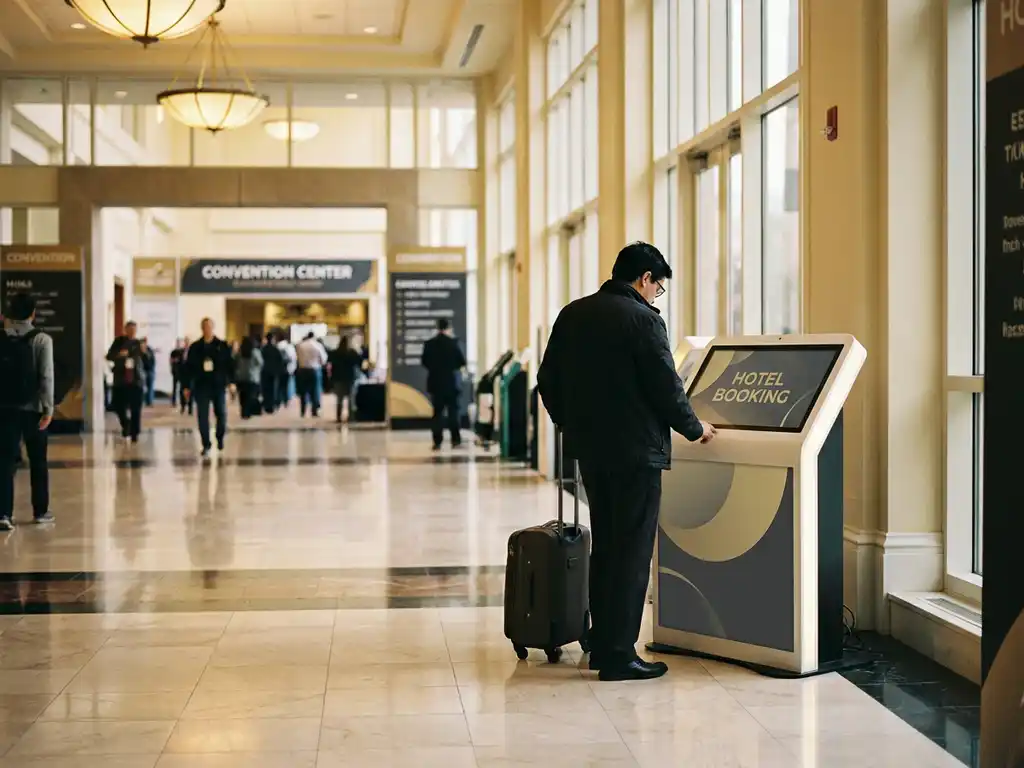
Exhibition visitors make their hotel booking decisions faster than you might expect. The moment someone registers for a trade show or conference, accommodation is often the next item on their checklist. Understanding what drives those decisions gives hotels near event venues a clear advantage when it comes to capturing qualified demand and increasing occupancy during event periods. Here is a look at the nine factors that most influence where exhibition visitors choose to stay.
How exhibition visitors choose their hotel
Exhibition attendees are not leisure travellers browsing for inspiration. They arrive at the booking process with specific requirements: they need to be close to the venue, they need flexibility in case plans change, and they want the process to be quick. Hotels that align their offer with these priorities are far better positioned to convert that intent into confirmed room nights.
1: Proximity to the exhibition venue
Distance from the venue is the single most decisive factor for the majority of exhibition visitors. When someone is attending a multi-day trade show, every extra minute of commuting adds up. Attendees carrying sample cases, presentation materials, or simply running between sessions have a strong preference for walking distance or a very short transfer.
Hotels that clearly communicate their proximity to a specific venue, including walking time and transport options, convert at a significantly higher rate than those that leave attendees to figure it out on their own. Visibility on event-linked booking pages that display distance to the venue puts proximity-focused hotels front and centre at exactly the right moment.
This factor matters most for multi-day events where attendees want to minimise daily travel and maximise time on the show floor or in meetings.
2: Appearance on official event booking pages
Trust plays an enormous role in the booking decisions of business travellers. When an attendee sees a hotel listed on the official event accommodation page, it carries an implicit endorsement from the organiser. That association reduces hesitation and drives faster booking decisions compared to discovering a hotel through a generic search.
Official event pages also capture visitors at peak intent, immediately after registration when accommodation is top of mind. Hotels that appear on these pages benefit from a captive, qualified audience rather than competing for attention across crowded OTA search results.
For hotels in convention and exhibition destinations, securing placement on official event booking channels is one of the highest-value distribution strategies available.
3: Room rate relative to event dates
Exhibition visitors are acutely aware that hotel prices spike around major events. Many have expense policies to navigate or are self-funding their attendance. Rates that feel disproportionate to the quality of the property or the length of stay create friction and push attendees toward alternatives.
Competitive pricing does not mean undercutting the market. It means offering rates that reflect genuine value for the convenience being provided. A hotel two minutes from an exhibition centre can justify a premium, but that premium needs to be anchored to a clear value proposition that the guest can immediately understand.
Transparent pricing with no hidden fees is particularly important for this audience. Business travellers submitting expense reports need predictability, and any unexpected charges at checkout create negative experiences that damage repeat bookings.
4: Flexible cancellation policies
Exhibition schedules shift. Corporate travel plans change. Attendees booking months in advance face genuine uncertainty about whether their participation will be confirmed closer to the event. A rigid non-refundable rate is often a dealbreaker for this audience, even if the price is attractive.
Offering at least one flexible rate option signals that the hotel understands the realities of business travel. Attendees are more likely to book early and at a higher rate if they know they are not locked in without recourse. The perceived risk of a non-flexible booking often outweighs the savings it offers.
Hotels that build cancellation flexibility into their event-period inventory frequently see stronger advance booking curves and better overall pickup rates as a result.
5: Room availability aligned with event dates
An exhibition visitor searching for accommodation during a specific three-day window needs availability across all three nights. A hotel that has rooms available on two of those nights but not the third is effectively unavailable to that guest. Fragmented availability is one of the most common reasons event-period demand goes uncaptured.
Managing room blocks specifically allocated to event dates, with availability that mirrors the full event schedule, ensures that hotels do not lose bookings to gaps in inventory. Real-time synchronisation between booking systems and room block management tools is essential for maintaining accurate availability throughout the booking window.
This is particularly relevant for larger events where demand builds over weeks and last-minute inventory gaps can result in significant lost revenue.
6: Brand familiarity and hotel reputation
Business travellers tend to default to brands and properties they have stayed at before. Familiarity reduces the cognitive load of making a booking decision, particularly when the traveller is focused on the event itself rather than the accommodation research process.
For independent hotels and boutique properties, reputation carries equivalent weight to brand recognition. Strong review scores on credible platforms, clear photography, and an accurate description of the property all contribute to the trust signals that tip undecided guests toward a booking.
Hotels with a track record of hosting event attendees well, and that communicate this clearly, build a compounding advantage over time as repeat visitors and word-of-mouth referrals strengthen their position in the event accommodation market.
7: Seamless booking experience
Exhibition visitors are often booking accommodation as one task among many in a busy pre-event preparation period. A booking process that is slow, confusing, or requires unnecessary steps will result in abandonment. The smoother the path from search to confirmation, the higher the conversion rate.
This applies to both the booking interface and the confirmation process. Guests expect immediate confirmation emails, clear booking references, and easy access to their reservation details. Properties that offer a frictionless event booking experience consistently outperform those that create unnecessary complexity.
Mobile optimisation is no longer optional. A significant proportion of exhibition attendees complete bookings on mobile devices, often while in transit or between sessions at a previous event.
8: Transport links and local connectivity
Not every attendee will be able to stay within walking distance of the venue. For those who cannot, transport connectivity becomes the deciding factor. Direct links to the exhibition centre via metro, tram, or shuttle service make a hotel viable even if it sits further from the venue.
Hotels that communicate transport options clearly, including journey times and frequency of service, reduce the uncertainty that deters bookings from guests who are unfamiliar with the local area. Maps, transfer guides, and information about shuttle services provided by the event organiser all contribute to a more confident booking decision.
For international attendees, proximity to airports and ease of navigation from the hotel to the venue are equally important considerations alongside the event itself.
9: On-site amenities for business travellers
Exhibition attendees often use their hotel as a working base throughout the event. Meeting rooms for client discussions, reliable high-speed Wi-Fi, early breakfast service, and business centre facilities are practical requirements rather than luxury extras for this audience.
Hotels that position these amenities clearly in their event-period communications attract a higher proportion of business travellers who are willing to pay a rate premium for the productivity benefits they provide. A guest who can take a client meeting in a hotel meeting room or prepare a presentation in their room before the show opens is a guest who books that property again next year.
Fitness facilities, on-site dining with flexible hours, and efficient check-in and check-out processes round out the amenity profile that resonates most strongly with the exhibition visitor segment.
How EventHost helps hotels capture exhibition demand
Understanding what exhibition visitors want is only half of the equation. The other half is being visible and available to them at the exact moment they are ready to book. This is precisely where we help hotel partners convert event-driven demand into confirmed room nights.
Through our platform, hotels gain access to a free listing service that connects properties directly to qualified, event-driven audiences without any marketing spend or upfront investment. Here is what that means in practice:
- Placement on official event booking pages so attendees discover your property through a trusted, organiser-endorsed channel at peak booking intent
- Live proximity display technology that shows attendees your exact walking or travel distance to the venue, turning location into a competitive advantage
- Flexible room block allocation that lets you upload availability and set your own pricing, cancellation policies, and inventory levels per event
- Real-time booking synchronisation with automated alerts at predefined thresholds so you always have full visibility into pickup rates
- Zero commission costs compared to OTA rates of 15 to 25%, with all guest inquiries, modifications, and payments handled entirely by our team
- Direct earnings transfer after each event concludes, with detailed reporting so you can evaluate performance and plan ahead
The result is a distribution channel that works specifically for the exhibition and conference segment, reaching high-intent bookers without the overhead of traditional hotel marketing. If you are looking to increase occupancy during event periods and reduce dependence on costly OTA channels, we would welcome the conversation. Get in touch with our team to find out how your property can be listed for upcoming events in your area.