
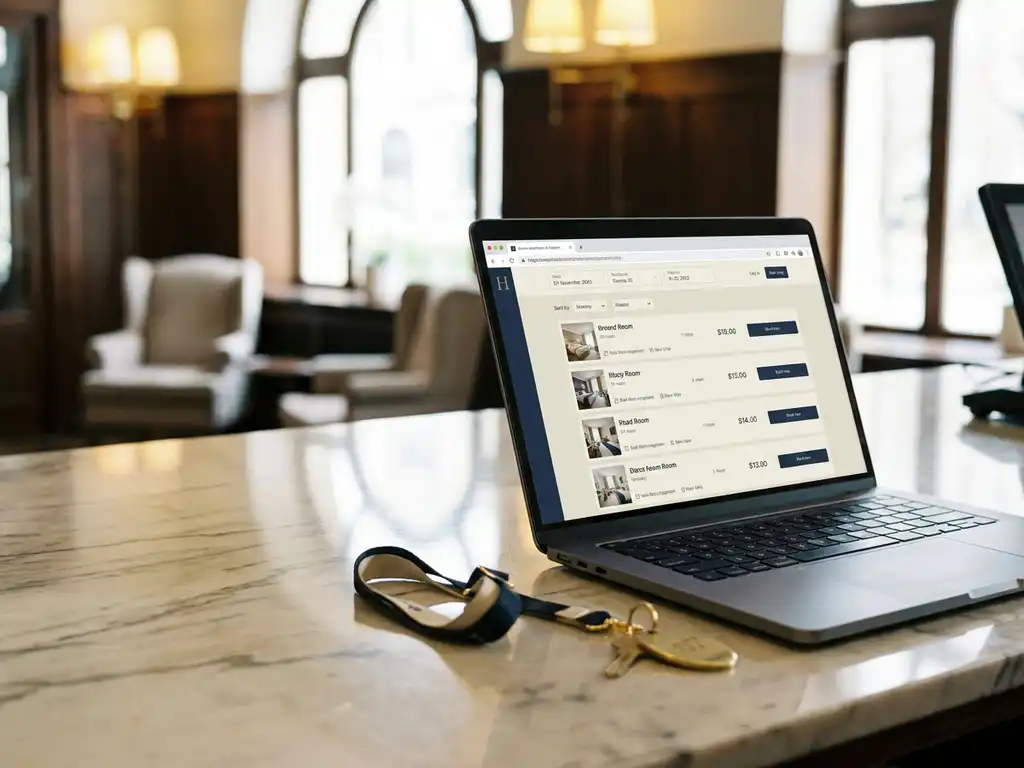
A hotel booking portal for events is a dedicated online platform that connects event attendees directly with hotels near a specific venue, allowing them to browse, compare, and reserve accommodation within the official event ecosystem. Unlike general travel sites, these portals are built around a single event or organizer, displaying only relevant properties with accurate distances to the venue. The sections below unpack how these platforms work, how they differ from standard booking channels, and what they mean for hotels looking to capture event-driven demand.
How does a hotel booking portal for events actually work?
An event hotel booking portal works by embedding a branded booking engine directly into an event’s website or registration flow, giving attendees a curated list of nearby hotels at the moment they are most likely to book. The portal pulls live room availability from hotel partners, displays properties by proximity to the venue, and processes reservations in real time without redirecting attendees to a third-party site.
The technical flow typically involves three layers working together. First, hotels upload their available inventory and set their own rates and cancellation terms. Second, the portal’s engine maps each property against the event venue, calculating actual walking or travel distances so attendees can make informed choices. Third, when a booking is confirmed, the system syncs the reservation instantly, updates remaining availability, and triggers alerts when inventory reaches predefined thresholds.
For attendees, the experience feels seamless. They move from registering for a conference or trade show directly into a hotel search filtered to properties that are actually close to where they need to be. For hotels, the booking appears in a centralized management dashboard where pickup rates, revenue, and room block status are visible in real time. This closed-loop model captures booking intent at its peak, immediately after an attendee commits to attending an event.
What’s the difference between an event hotel portal and a standard OTA?
The core difference is intent and context. A standard OTA like Booking.com or Expedia serves a broad audience searching for accommodation across any destination for any reason. An event hotel booking portal serves a defined audience, attendees of a specific event, who need accommodation near a specific venue on specific dates. The demand is pre-qualified before the search even begins.
This distinction has meaningful consequences for hotels on both sides of the comparison.
Distribution cost
OTAs typically charge hotels commissions in the range of 15 to 25 percent per booking. Event hotel portals operate on a fundamentally different economic model, often taking a smaller commission shared with the event organizer rather than charging the hotel directly. For hotels trying to reduce OTA dependency, event portals represent a lower-cost channel for reaching high-intent bookers.
Booking context and conversion
On a standard OTA, a hotel competes against hundreds of properties in the same city, often on price alone. On an event portal, the competitive set is limited to hotels that have opted into that specific event, and proximity to the venue becomes the primary filter. Attendees are not browsing leisurely. They have already decided to attend the event and simply need a place to stay nearby, which means conversion rates tend to be significantly higher than on general travel platforms.
What types of events use hotel booking portals?
Hotel booking portals for events are most commonly used by large-scale gatherings where attendee accommodation is a logistical priority and where the volume of room nights justifies a dedicated booking infrastructure. The most frequent applications include conferences, trade shows, conventions, professional summits, and sports tournaments.
Industry conferences and trade shows are the clearest fit. Events like major business-to-business expos, medical congresses, or technology summits routinely attract thousands of attendees who need accommodation within easy reach of a convention center. Managing that volume through informal email chains or generic hotel websites creates friction and lost bookings, which is why professional event organizers in these sectors have been early adopters of dedicated portals.
Sports tournaments, particularly those that span multiple days or involve traveling teams and supporters, also rely heavily on structured hotel booking solutions. Organizers need to allocate blocks across multiple properties, track pickup in real time, and release unsold inventory before cancellation deadlines.
Smaller professional gatherings, corporate retreats, and association meetings are increasingly adopting the same model as the technology has become more accessible and easier to implement without technical overhead.
How do hotels maintain pricing and inventory control on these platforms?
Hotels retain full control over their rates, room allocation, and cancellation policies when joining an event hotel booking portal. The portal does not set prices or dictate availability. Instead, it provides the infrastructure through which hotels publish their own terms and manage their own inventory on a per-event basis.
In practice, this means a hotel can decide exactly how many rooms to allocate to a specific event, set a rate that reflects the demand profile of that event, and define cancellation conditions independently of what they offer on other channels. If the hotel wants to apply a stricter cancellation policy for a high-demand conference or offer a more competitive rate for a midweek event with softer demand, those decisions remain entirely with the revenue management team.
Inventory management on well-built platforms is handled through a live hotel room block management system. Bookings sync in real time, so the hotel’s dashboard always reflects current pickup. Automated alerts notify the hotel when a block reaches a defined threshold, giving revenue managers time to release inventory back to general availability or add more rooms if demand warrants it. This level of visibility and control is considerably more sophisticated than managing event blocks through manual spreadsheets or email correspondence with individual organizers.
What does it cost hotels to join an event hotel booking portal?
Joining an event hotel booking portal is typically free for hotels. There are no setup fees, no subscription costs, and no upfront investment required. The platform earns revenue through a commission on completed bookings, which is shared with the event organizer, meaning the hotel only pays when a booking actually occurs and generates revenue.
This structure eliminates financial risk for hotel partners. A hotel can list its inventory for a specific event, participate in the official event attendee accommodation channel, and incur no cost if bookings do not materialize. When bookings do convert, the commission rate is typically more favorable than standard OTA fees, making the channel economically attractive relative to existing distribution options.
Hotels also avoid the hidden costs that come with managing event-related business through traditional channels, including staff time spent coordinating room blocks, handling group inquiries, and reconciling payments. On a managed portal, customer service, booking modifications, and payment processing are handled by the platform, freeing hotel staff to focus on operations rather than administration.
How EventHost helps hotels capture event-driven demand
EventHost is built specifically to solve the challenges covered in this article, connecting hotels to qualified event demand at no upfront cost and with no operational burden. Through our Hotel Partnership Network, hotels can:
- List rooms and allocate inventory to specific events entirely on their own terms
- Appear on official event booking pages with full branding and live proximity data
- Retain complete control over pricing, availability, and cancellation policies
- Access a real-time hotel block management dashboard with automated pickup alerts
- Receive payment directly after each event concludes, with no chasing required
- Hand off all guest inquiries, booking modifications, and customer service to our team
There are no setup fees, no subscription costs, and no hidden charges. EventHost only earns when hotels earn. If you manage a property near major conferences, trade shows, or professional events and want to capture that demand without increasing OTA dependency, join the EventHost hotel partner network today and start appearing on official event booking pages in your area.