
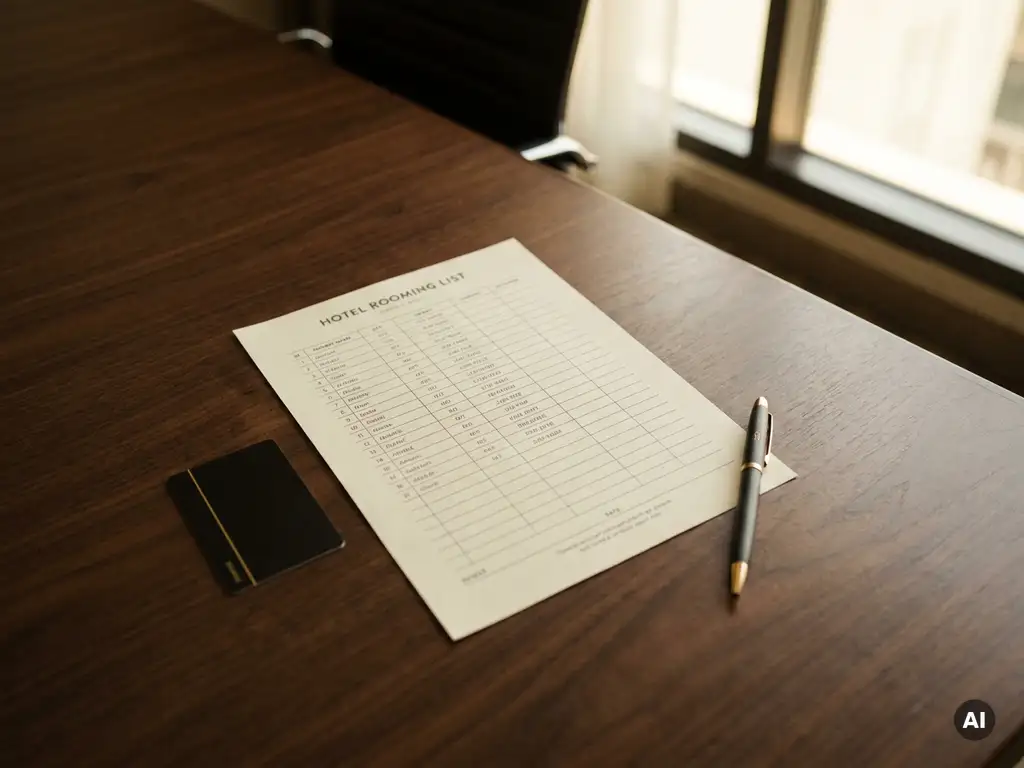
A hotel rooming list is a document provided by an event organizer or group coordinator that details the names, room types, check-in and check-out dates, and special requirements for each guest in a group booking. It gives the hotel everything it needs to pre-assign rooms, prepare welcome amenities, and manage billing accurately before the group arrives. This article walks through the key questions hotels and event organizers ask about rooming lists, from what they contain to how modern platforms are changing the way they are managed.
What information does a hotel rooming list include?
A hotel rooming list includes the full name of each guest, their room type, arrival and departure dates, any special requests, and billing instructions. It acts as the master reference document that allows a hotel to match individual guests to pre-negotiated room block inventory before check-in, reducing front desk congestion and improving the guest experience.
While formats vary between organizers and properties, a complete rooming list typically contains the following fields for each guest:
- Guest full name (as it will appear on identification)
- Room type requested (single, double, twin, suite, accessible room)
- Check-in and check-out dates
- Special requests (bed configuration, floor preference, dietary needs for in-room amenities)
- Billing arrangement (direct bill to master account, individual credit card, split billing)
- VIP status or loyalty programme membership
- Contact email or phone number for pre-arrival communication
Some organizers also include the guest’s company or organisation name, which is particularly useful for large conferences where multiple companies are represented within the same room block. The more complete the rooming list, the smoother the hotel’s pre-arrival preparation process will be.
When does a hotel need a rooming list from an event organizer?
A hotel typically needs a completed rooming list between 14 and 30 days before the event’s arrival date. The exact deadline is usually written into the group contract and is tied to the hotel’s internal pre-arrival workflow, room assignment schedule, and housekeeping preparation timeline.
Receiving the rooming list too late creates real operational problems. Room assignments cannot be made in advance, billing instructions are unclear at check-in, and front desk staff spend valuable time resolving issues that should have been handled days earlier. For large groups of 50 rooms or more, many hotels request the list 30 days out to allow enough lead time.
There is also a practical reason tied to attrition clauses. If a room block includes a minimum pickup commitment, the hotel needs the rooming list early enough to identify whether the contracted number of rooms will actually be filled. This gives both parties time to adjust before financial penalties apply.
For events that span multiple arrival days, such as a week-long conference, organizers often submit rooming lists in waves as delegate registrations are confirmed, with a final consolidated list submitted by the contract deadline.
What’s the difference between a rooming list and a room block?
A room block is the inventory of rooms a hotel sets aside for a specific event or group at a negotiated rate. A rooming list is the guest-level document that assigns individual names to the rooms within that block. The room block is the agreement; the rooming list is the fulfilment of that agreement.
Think of it this way: a room block reserves 80 rooms at a conference rate from Tuesday to Thursday. The rooming list then tells the hotel exactly which 80 guests are occupying those rooms, what room type each needs, when each person arrives, and how each stay will be billed.
The two documents operate on different timelines as well. A room block is typically contracted months before an event, often at the same time the event venue is confirmed. The rooming list comes much later, once individual attendee registrations have been collected and room assignments can be made. Understanding this distinction matters for hotel group sales teams because the block represents potential revenue, while the rooming list represents confirmed, named demand.
How do you create a hotel rooming list step by step?
Creating a hotel rooming list involves collecting guest details from registrations, organising them by arrival date and room type, confirming billing arrangements, and submitting the completed document to the hotel by the contracted deadline. A clear process prevents errors that cause check-in delays and billing disputes.
Follow these steps to build an accurate rooming list:
- Gather your guest data. Pull confirmed registrations from your event management or ticketing system. Collect full legal names, room type preferences, and check-in and check-out dates for every guest requiring accommodation.
- Match guests to room types. Cross-reference the room types requested against the inventory available in your contracted room block. Flag any requests that exceed what was negotiated (for example, suite requests when only standard rooms were blocked).
- Clarify billing for each guest. Determine whether each stay is billed to a master account, charged to the individual guest’s card, or split between the two. This is one of the most common sources of check-in confusion, so getting it right in the rooming list saves significant time.
- Note special requests. Record any accessibility requirements, bed configuration preferences, or VIP designations. Pass these to the hotel’s housekeeping and front office teams in advance.
- Use a consistent format. A hotel rooming list template in spreadsheet format (with one row per guest and consistent column headers) is the most universally accepted format. Confirm with the hotel what format they prefer before submitting.
- Review and submit before the deadline. Audit the list for missing fields, duplicate entries, or mismatched dates. Submit to your hotel contact with enough lead time for them to action pre-assignments and flag any issues back to you.
Keeping a master spreadsheet that you update in real time as registrations come in makes the final submission far less stressful than compiling everything from scratch at the last minute.
What are the most common rooming list mistakes?
The most common rooming list mistakes are submitting the list too late, using inconsistent guest name formats, leaving billing arrangements blank, and failing to account for early arrivals or late departures that fall outside the contracted room block dates.
Each of these errors creates a specific problem at the hotel:
- Late submission leaves the hotel unable to pre-assign rooms, increasing check-in wait times and frustrating guests who expect a smooth arrival.
- Name mismatches between the rooming list and the guest’s identification document cause front desk delays, particularly when ID checks are required for billing purposes.
- Missing billing instructions result in awkward conversations at check-out when guests are unexpectedly asked to provide payment for stays they believed were covered.
- Ignoring shoulder nights means guests who arrive a day early or depart a day late are not included in the block rate, and they end up booking through OTAs or calling the hotel directly at a higher rate.
- Not sending updates when guests cancel or change their plans leaves the hotel holding room assignments for guests who will not arrive, which can trigger attrition penalties unnecessarily.
Building a revision process into your timeline, where you send the hotel an updated rooming list if significant changes occur after the initial submission, reduces the risk of these errors affecting the event experience.
Can rooming lists be managed through hotel booking platforms?
Yes, modern hotel booking platforms can significantly reduce or even eliminate the manual rooming list process by automating guest data collection, room assignment, and real-time inventory tracking. Instead of organizers compiling spreadsheets and emailing them to hotels, platforms can sync booking data directly to the hotel’s system as reservations are made.
Traditional rooming list management is labour-intensive because it relies on data flowing between multiple parties, event organizers, hotels, and individual guests, through disconnected channels like email and spreadsheets. Errors accumulate at every handoff. Platforms that connect directly to event hotel booking workflows replace this with live data that updates automatically as guests book, modify, or cancel their stays.
For hotels, this means room pickup data is visible in real time rather than arriving as a static document weeks before the event. Revenue managers can monitor how quickly a block is filling, identify slow-moving room types, and make pricing or allocation decisions based on current data rather than estimates.
For event organizers, the administrative burden of chasing guest information and formatting rooming list templates is removed. Guests book their own rooms within the event’s designated block, and the hotel receives structured, accurate data automatically.
How EventHost simplifies hotel rooming list and room block management
Managing rooming lists manually is one of the most time-consuming parts of event hotel coordination, and it is also where errors are most likely to occur. EventHost replaces this process with a fully managed, technology-driven system that handles the entire accommodation workflow on behalf of both hotels and event organizers.
Here is what we take off your plate:
- Real-time booking sync: Guest bookings flow directly into a centralised hotel block management system, so room pickup data is always current without anyone manually updating a spreadsheet.
- Automated threshold alerts: Hotels receive notifications when room blocks reach predefined pickup levels, enabling proactive inventory decisions.
- Guest-level data accuracy: Because guests book their own rooms through the event’s official booking page, name, room type, and date information is captured at source, eliminating transcription errors from manual rooming lists.
- Full customer service management: We handle all guest inquiries, modifications, and cancellations, removing the back-and-forth coordination that typically falls on hotel group sales teams.
- Zero cost to join: Hotels can list their property and allocate inventory to specific events at no charge, with no subscription fees or upfront investment required.
- Post-event reporting: Detailed summaries of room pickup and revenue are provided after each event, giving hotels clear performance data without building their own tracking systems.
If your hotel is near a conference venue, convention centre, or major event destination and you want to capture qualified, event-driven demand without the manual overhead of traditional group booking coordination, join the EventHost hotel network and let us manage the process for you.