
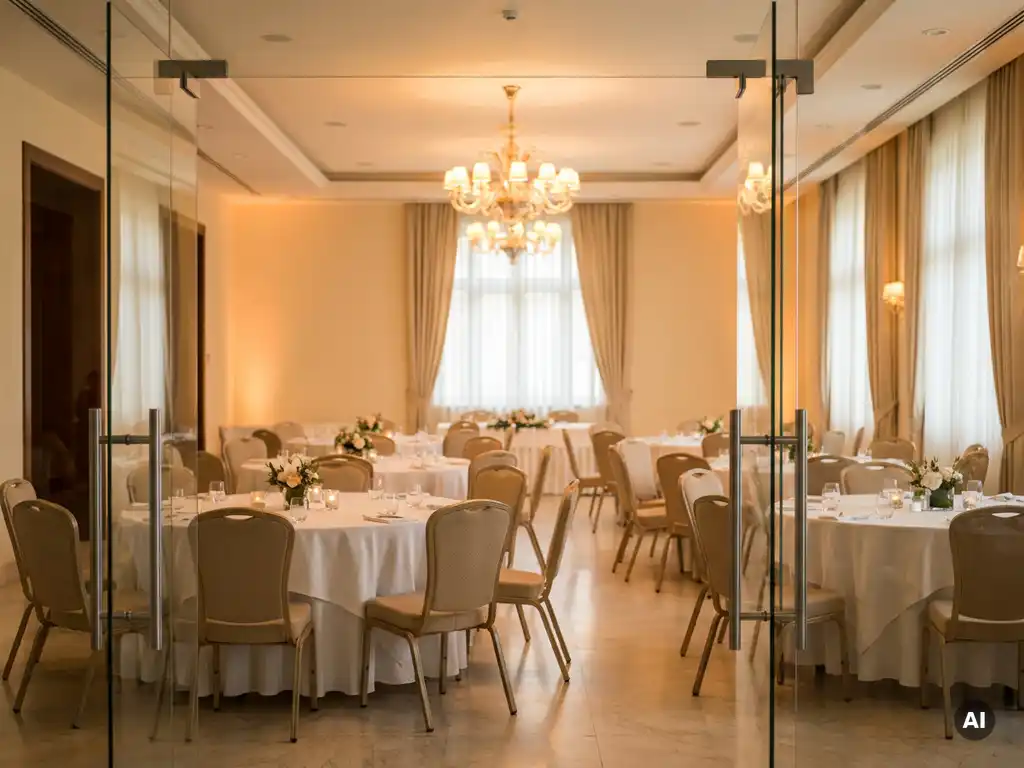
Choosing the right hotel for a corporate conference comes down to three core factors: location relative to the venue, meeting facilities that match your event’s scale, and a room block agreement that works for your attendees and your budget. The best conference hotels combine convenient proximity, professional event infrastructure, and flexible accommodation options under one roof or within easy reach of each other. The questions below walk through every major decision point, from initial criteria to negotiation and booking logistics.
What makes a hotel suitable for a corporate conference?
A hotel is suitable for a corporate conference when it can reliably support both the meeting programme and the accommodation needs of attendees. That means dedicated meeting space with the right capacity, reliable audiovisual infrastructure, strong Wi-Fi, catering services, and enough guest rooms to house a significant portion of delegates without requiring multiple overflow properties.
Beyond the basics, the most effective conference hotels offer a professional environment where business gets done. Think about the flow between meeting rooms, breakout spaces, and dining areas. Delegates who can move seamlessly from a general session to a breakout, to lunch, and back without leaving the building are more focused and more productive.
Key criteria to evaluate when assessing a hotel for a corporate conference include:
- Meeting room capacity: Can the largest space accommodate your full delegate count in your preferred layout (theatre, classroom, or cabaret)?
- Breakout rooms: Are there enough smaller rooms for workshops, roundtables, or one-to-one meetings?
- AV and technology: Does the hotel provide in-house AV support, stable high-speed Wi-Fi, and presentation equipment?
- Catering flexibility: Can the kitchen handle dietary requirements, multiple meal formats, and refreshment breaks on a tight schedule?
- Guest room count: Does the property have enough rooms to house your core attendee group without fragmenting the group across multiple hotels?
- Dedicated events staff: Is there a named conference coordinator who manages your event on-site?
Properties that tick these boxes consistently deliver better delegate experiences and fewer logistical headaches for organizers.
How important is hotel location for a corporate conference?
Hotel location is one of the most important factors in corporate conference hotel selection. Attendees who are tired, jet-lagged, or working to tight schedules will always favour accommodation that minimizes travel time to the event venue. A hotel that is within walking distance or a short direct transfer from the conference venue dramatically reduces late arrivals, logistical stress, and the risk of delegates missing key sessions.
For multi-day conferences, proximity also affects evening engagement. Delegates staying close to the venue are more likely to attend networking dinners, informal sessions, and early-morning starts. Those staying further away often skip optional programming, which reduces the return on the event investment for both organizers and sponsors.
When evaluating location, consider:
- Walking distance or direct transfer time from hotel to venue
- Proximity to the airport or main transport hub for international delegates
- Availability of taxis, public transport, or a shuttle service
- Nearby amenities such as restaurants, pharmacies, and fitness facilities
- Safety and ease of navigation for first-time visitors to the city
If the primary venue is a standalone conference centre rather than a hotel, sourcing accommodation blocks at hotels within a short, clearly defined radius of the venue becomes the central accommodation challenge for organizers.
What questions should you ask a hotel before signing a contract?
Before signing any hotel contract for a corporate conference, you need clear answers on room block commitments, attrition clauses, cancellation terms, meeting space exclusivity, and what is included in the delegate day rate. Signing without clarity on these points is where most conference budgets run into trouble.
A strong pre-contract checklist should cover the following areas:
Room block and attrition
- What is the minimum room block you are committing to, and what is the attrition percentage (the proportion of rooms you must sell before penalties apply)?
- What happens to unsold rooms after the release date?
- Are rooms available at the contracted rate for attendees who book after the release date?
Meeting space and exclusivity
- Is the meeting space exclusively allocated to your event, or could another group be placed in an adjacent room?
- What are the setup and breakdown times, and are these included in the room hire fee?
- Are there noise or capacity restrictions that could affect your programme?
You should also ask about the hotel’s policy on external suppliers (some properties require you to use their in-house AV team), whether Wi-Fi is included in the day rate or charged per device, and who your named point of contact will be on the day of the event. Getting these answers in writing before signing protects you if staff change or expectations shift.
How do you negotiate a room block for a corporate conference?
Negotiating a room block for a corporate conference means securing a set number of guest rooms at an agreed rate, with clearly defined pickup obligations, release dates, and attrition terms. The stronger your historical booking data and the more flexible your dates, the more leverage you have to negotiate favourable terms.
Hotels value group business because it fills rooms in predictable blocks, often during midweek periods that are harder to fill through leisure travel. Use that to your advantage. If your conference falls on a Tuesday to Thursday, the hotel has a strong incentive to offer competitive rates and softer attrition clauses to guarantee occupancy on those nights.
Practical negotiation points to raise include:
- Attrition percentage: Aim for 80% or lower rather than accepting the default 90%
- Complimentary rooms: Industry standard is one complimentary room per 40 to 50 paid rooms – negotiate this in writing
- Rate parity: Ensure the contracted rate is at or below what attendees could find on a standard OTA search at the time of booking
- Release date flexibility: Push for a later release date so you have more time to fill the block before penalties apply
- Shoulder night rates: If some attendees arrive a day early or stay a day late, negotiate the same group rate for those nights
Always compare offers from at least two or three hotels before committing. Competition between properties, especially in cities with multiple conference-grade hotels, gives you real negotiating power.
What’s the difference between a conference hotel and a conference centre?
A conference hotel combines meeting facilities and guest accommodation in the same property, while a conference centre is a dedicated event facility that typically does not offer on-site accommodation. Both can host high-quality corporate conferences, but they suit different types of events and attendee profiles.
Conference hotels are generally the preferred choice for multi-day events where keeping delegates together matters. The convenience of moving from a bedroom to a breakfast meeting to a general session without leaving the building creates a contained, focused environment. It also simplifies logistics for organizers because catering, AV, accommodation, and event management are coordinated through a single venue team.
Conference centres, by contrast, often offer larger, more flexible event spaces and purpose-built auditoriums that hotel ballrooms cannot match. They are well suited to large-scale trade shows, conventions, and events where the meeting space itself is the primary requirement and accommodation is sourced separately from nearby hotels. Cities like Frankfurt and Las Vegas have built entire hospitality ecosystems around major conference centres, with dozens of hotels within walking distance serving as the accommodation layer for events hosted in the centre.
The practical implication for organizers is that choosing a conference centre means taking on the additional task of managing hotel accommodation for attendees as a separate workstream, rather than having it bundled into a single venue contract.
How can event organizers simplify hotel booking for conference attendees?
Event organizers can simplify hotel booking for conference attendees by providing a curated, proximity-based list of recommended hotels linked directly from the event registration page, with pre-negotiated rates and a clear booking process. The fewer steps between registration and confirmed accommodation, the higher the booking conversion rate and the lower the volume of attendee queries the organizing team has to handle.
The most common friction points in conference hotel booking are:
- Attendees searching independently and booking hotels that are far from the venue
- Room blocks filling up because the booking link was buried in a confirmation email
- Organizers spending hours answering accommodation questions that a clear booking page would resolve
- No visibility into how many attendees have booked, making it hard to manage room block commitments
Embedding a dedicated hotel booking experience directly within the event website addresses all of these issues at once. When attendees can see hotels ranked by walking distance to the venue, compare rates, and complete a booking without leaving the event platform, conversion rates improve and organizer workload drops significantly. This approach also captures booking intent at the highest-probability moment: immediately after a delegate registers for the event.
How EventHost simplifies hotel booking for corporate conferences
EventHost is built specifically to solve the accommodation challenge that every corporate conference organizer faces. Rather than leaving attendees to search independently or burdening your team with hotel coordination, we provide a fully managed, white-label hotel booking solution that sits directly inside your event website at zero cost to you.
Here is what working with us looks like in practice:
- Live map technology: Attendees see hotels ranked by real walking or travel distance from your conference venue, so proximity-based decisions are instant and accurate
- 2.7 million hotels worldwide: Your attendees always have relevant, well-located options regardless of where your event is held
- White-label integration: The booking experience carries your event branding throughout, building trust and keeping attendees within your ecosystem
- Zero setup cost: There are no fees, no subscriptions, and no technical overhead for your team to manage
- Passive commission revenue: Every hotel booking made through your page generates commission earnings that are paid directly to you after the event
- Full customer service management: We handle all attendee enquiries, booking modifications, and cancellations so your team stays focused on the event itself
- Post-event reporting: You receive a detailed summary of booking data and commission earned after each conference concludes
If you are organizing a corporate conference in 2026 and want to offer attendees a seamless, proximity-first hotel booking experience while generating a new revenue stream, explore the EventHost platform and get started at no cost.